
A different school to guide the child in their learning and discoveries.
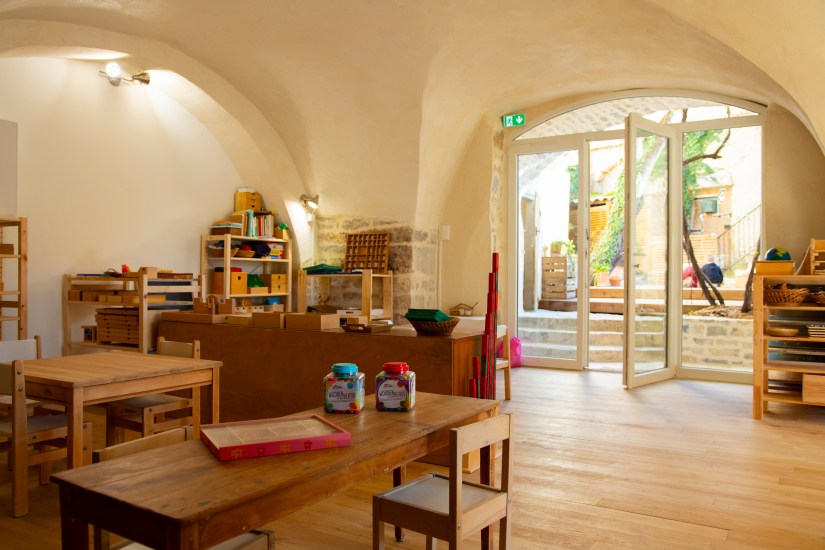
COOPERATION
MULTILINGUALISM
OPENNESS TO THE WORLD AND NATURE
A project based on:
- cooperation (discovery of self and others)
- education through nature (observation and experimentation)
- multilingualism (a Francophone teacher, an Anglophone teacher, multilingual international reception)
- autonomy and well-being of the child
The benefits of schooling at L’Ecole du Chemin:
respect for each child’s pace
small workforce (less than 15 children)
differentiated pedagogies tailored to specific needs
adaptation of Freinet and Montessori ways
News
The Finnish educational model:
A look back at a professional experience that was decisive for the creation of L’Ecole du Chemin.

For three years, from 2009 to 2012, I experimented with the Finnish educational model by taking charge of preschool classes (3 to 6 years old) within the Franco-Finnish sector in Tampere.
My mission was to offer linguistic immersion in French while respecting the educational values of the Scandinavian model.
By discovering this method in practice, I was able to understand the need to respect the learning rhythms of each child and to implement even more sustained individual attention for each of them.
I was also able to develop my practice of a pillar of this system for preschool: learning through play with children.
The objectives of this educational model
This educational system, one of the best in the world according to the OECD PISA ranking, is today validated by the contribution of neuroscience and is used in various alternative pedagogies.
Many professionals from the world of research and education attest that academic success does not depend on the school, but on its learning system and its pace of teaching.
The originality of this model is based on the application of a daily school rhythm different from our French system, as well as on the quality of the attention and individual support provided to students.
It is based on the idea that each child is a being in their own right who has their own learning periods and systems and who therefore deserves special attention and respect for themselves.
The child’s support follows the concept of multiple intelligences in order to help them fully develop their potential in the safe and stable environment that constitutes a caring school setting.
The relationship with the teacher is based on egalitarianism and cooperation, both between supervisors and students, as well as between children.
Individualized attention
Each child receives the necessary attention based on their maturity, needs and difficulties.
The child is free to progress at his own pace, while remaining supported and encouraged by the teacher.
This educational principle gives teachers the flexibility necessary to achieve objectives based on the child’s maturity while aiming to help them know themselves and develop self-confidence, autonomy and initiative.
Respecting the stages of child development
To be optimized, learning requires respect for the child’s stages of cognitive and emotional development.
It is by allowing the child to make their acquisitions at their own pace, to experiment with the right to make mistakes, that they gain self-confidence and learn to take responsibility. He can thus develop his qualities of initiative and creativity while retaining his critical spirit and his free will.
Play: a caring partner in child development
Although it is obvious to offer numerous games (educational, creative, cooperation, motor skills, social, balance, reflection, strategic, etc.) to children, due to their educational richness and the concrete application in learning, it is above all the fact of taking the time to participate in children’s games in class and outside, to be present most often at the heart of their own play, to follow them and encourage them in their spontaneous creativity. Being fully aware, in the present moment, with them.
This approach allows children to develop multiple skills favorable to their cognitive and emotional awakening.
It allows the adult to observe more precisely the rhythms and needs of each of the children in their group.
Finally, it allows everyone to develop a serene and caring relationship based on trust, sharing, complicity and joy.
©François Dassigny 06/10/2023
L’Ecole du Chemin
 L'ÉCOLE DU CHEMIN